Breakthrough Study Reveals Effective Strategies Against Olive Tree-Killing Bacterium
Location: Apulia, Italy
In the olive-rich region of Apulia, Italy, a relentless pathogenic bacterium, Xylella fastidiosa, has been wreaking havoc on olive trees since 2013, causing widespread concern among farmers and environmentalists. Traditional containment methods have shown limited success in curtailing its spread. However, a recent breakthrough study now offers new hope in the form of innovative endotherapeutic treatments. Endotherapy is an efficient way to deliver agrochemicals, growth regulators, defense activators, plant biostimulant and fertilisers in many tree species and offers some advantages to other systems (i.e foliar applications). Researchers chose this application method to give bioactive compounds in an environmental way to control bacteria, fungi and insects.
Background
Xylella fastidiosa, responsible for the dreaded Olive Quick Decline Syndrome, has not only threatened olive production but has also impacted the region’s economy, culture, landscape, and biodiversity. In response to this crisis, researchers at the CREA Research Centre for Olive, Fruit and Citrus Crops in Rende, Italy have been exploring alternative strategies to counteract the bacterium’s devastating effects.
Cutting-Edge Methods
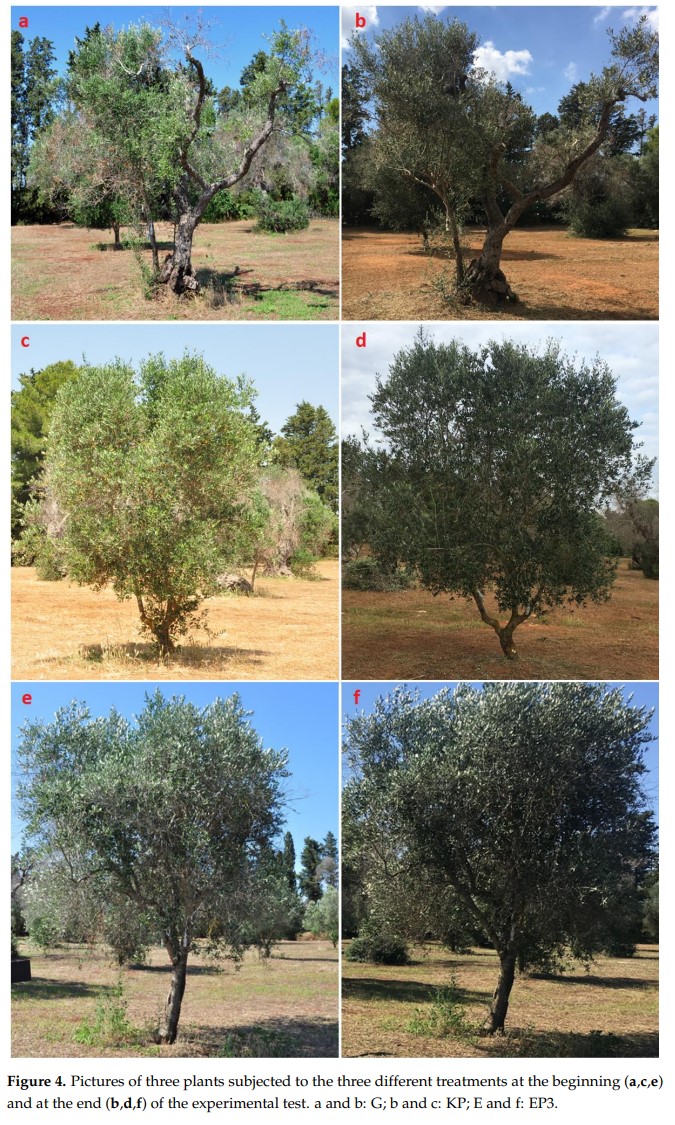
This groundbreaking study employs a multi-faceted approach, testing the efficacy of three distinct treatments:
- Phenolic Extract from Olive Leaves: This treatment involves the injection of phenolic compounds derived from fresh olive leaves into infected trees. The aim was to determine whether these compounds could combat the bacterium and promote tree health.
- Garlic-Powder-Based Solution: Another treatment under examination was a solution based on garlic powder, known for its antibacterial properties to determine whether they may be any effectiveness against Xylella fastidiosa.
- Potassium Phosphite: Potassium phosphite, with its reputation as a plant growth booster, was also included in the study to assess its potential as a bacterium control and tree recovery agent.
Promising Results
The in-depth study, conducted over two years in naturally infected olive trees in Apulia, yielded several noteworthy findings:
- Phenolic Extract: The injection of phenolic compounds from olive leaves demonstrated remarkable results. There was a significant increase in Leaf Area Index (LAI) and Leaf Area Density (LAD), indicating improved foliage density and growth. Furthermore, the treatment stimulated the growth of healthy shoots. Its bacteriostatic properties, as observed in laboratory tests, underlined its potential.
- Garlic-Powder-Based Solution: Although this solution exhibited bacteriostatic properties in the laboratory, its impact on foliage density in the field was limited. It did not significantly promote vegetative growth in olive trees.
- Potassium Phosphite: Potassium phosphite emerged as a valuable contender. It not only showed effectiveness in controlling the bacterium but also acted as a robust plant-growth booster, contributing to healthier olive trees.

Looking Ahead
These findings are a ray of hope for Apulia’s beleaguered olive industry. Since 2013, Xylella fastidiosa has posed a severe threat to olive farming, local culture, and the region’s biodiversity. It is evident that novel approaches are urgently needed to combat this menace effectively.
The innovative endotherapeutic treatment involving phenolic extracts from olive leaves offers a cost-effective and eco-friendly solution. The inplanta evaluation of the treatments showed a statistically significant greater efficacy of the phenolic solution in stimulating the trees’ vegetative growth expressed as a percentage increase in LAI and LAD as well as growth of newly formed healthy shoots. Its capacity to stimulate olive tree growth while combatting the bacterium is a promising sign.
While the garlic-powder-based solution showed potential in controlling planktonic growth, its limited impact on vegetative growth raises questions about its suitability for wide-scale adoption. In contrast, potassium phosphite’s dual role as a bacterium controller and plant growth enhancer makes it a valuable asset in the fight against Xylella fastidiosa.
The success of this study in controlled experiments opens the door for further research and application on a larger scale. While it may not be the perfect solution for ancient olive trees, it offers hope for safeguarding the future of olive cultivation in Apulia. These findings mark a significant step forward in the battle against Xylella fastidiosa and its devastating consequences for Apulia’s olive industry and ecosystem.
Read full article: Phenolic Extract from Olive Leaves as a Promising Endotherapeutic Treatment against Xylella fastidiosa in Naturally Infected Olea europaea (var. europaea) Trees …
Contact The Olive Centre
Citation: Vizzarri, V.; Ienco, A.; Benincasa, C.; Perri, E.; Pucci, N.; Cesari, E.; Novellis, C.; Rizzo, P.; Pellegrino, M.; Zaffina, F.; et al. Phenolic Extract from Olive Leaves
as a Promising Endotherapeutic Treatment against Xylella fastidiosa in Naturally Infected Olea europaea (var. europaea) Trees. Biology 2023, 12, 1141. https://doi.org/10.3390/biology12081141
 Amanda Bailey on Olives by The Olive Centre