In the highly competitive world of extra virgin olive oil (EVOO) production, achieving the perfect balance between oil yield and quality is critical. Quality of EVOO is also directly influenced by the decanter centrifuge settings during the extraction process. Key parameters, such as the differential speed between the drum and screw (referred to as Dn) and the use of two-phase versus three-phase decanters, play a pivotal role in determining the chemical composition, sensory profile, and overall quality of the final product.
This technical article provides an in-depth look at how adjusting these decanter parameters can optimise EVOO quality, with a focus on key factors such as antioxidant retention, volatile compound profiles, and oxidative stability.
The Role of Decanters in Olive Oil Extraction
The decanter is a horizontal centrifuge used to separate the olive oil from the water and solid phases of the olive paste. Two main types of decanters are used in commercial olive oil production:
- Two-phase decanter: This system does not require the addition of water, resulting in denser pomace and higher retention of phenolic compounds. The absence of added water enhances the oil’s antioxidant properties and produces oils with stronger sensory characteristics such as bitterness and pungency.
- Three-phase decanter: This method involves adding water during the centrifugation process. While this dilutes phenolic compounds, it allows for the retention of tocopherols and carotenoids, which are crucial for oil stability and nutritional value. Three-phase systems produce oils with more pronounced fruity notes, but generally lower antioxidant content compared to two-phase systems.
Understanding Dn: Differential Speed Between Drum and Screw
A critical factor in the decanter’s performance is Dn, or the differential speed between the drum and the screw. The drum rotates at a high speed to generate centrifugal force, while the screw moves at a different speed to transport the solid residues (pomace) out of the decanter. The speed difference between these components directly impacts the efficiency of separation and the quality of the oil:
- Higher Dn (e.g. Dn16): A greater difference in speed leads to faster separation of the olive oil from the paste, reducing the oil’s exposure to oxidation. However, faster separation can result in less time for the extraction of phenolic compounds and other antioxidants from the paste.
- Lower Dn (e.g. Dn11): A smaller differential speed slows down the separation process, allowing for more thorough extraction of phenolic compounds but potentially increasing the risk of oxidation due to prolonged contact with oxygen and water.
Insight On How Decanter Parameters Influence Oil Quality
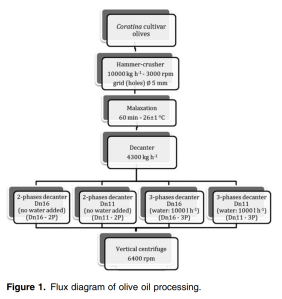
An experimental study conducted using Coratina olives processed under different decanter conditions (two-phase and three-phase systems, and Dn16 versus Dn11) sheds light on how these variables affect olive oil quality.
- Phenolic Compounds and Antioxidant Activity
Phenolic compounds are vital for EVOO’s antioxidant properties and contribute to its bitterness and pungency. Oils extracted using two-phase decanters were found to have significantly higher levels of phenolic compounds, particularly when operating at lower differential speeds (Dn11). The lower addition of water in two-phase systems helps retain hydrophilic antioxidants like phenols. In contrast, the three-phase system, which adds water, led to a reduction in phenolic content, especially at lower speeds (Dn11).
Oils extracted at higher speeds (Dn16) demonstrated increased antioxidant activity, likely due to reduced oxidative degradation during faster processing. This finding suggests that higher Dn values can limit oxidation and preserve the oil’s stability, though this comes at the cost of some loss in phenolic content. - Tocopherols and Carotenoids
Tocopherols (vitamin E) and carotenoids are essential for the oil’s shelf life and its nutritional benefits. The three-phase decanter retained significantly higher levels of these compounds, especially at higher speeds (Dn16). The addition of water during extraction enhances the solubility of these lipid-soluble antioxidants, resulting in higher concentrations in the final oil. Oils rich in tocopherols and carotenoids are more stable and less prone to oxidative degradation, making them particularly suitable for long-term storage. - Peroxide Value and Oxidative Stability
Peroxide value (PV) is an important indicator of the initial oxidation level of olive oil. The study found that oils extracted at higher speeds (Dn16) in two-phase decanters exhibited the lowest PVs, indicating better oxidative stability. This is consistent with the faster separation of the oil from the paste, minimising exposure to oxygen. In contrast, oils from the three-phase decanter, particularly at lower speeds (Dn11), showed higher PVs, reflecting increased oxidation during the extraction process. - Volatile Compounds and Sensory Profile
Volatile compounds are responsible for the characteristic flavours and aromas of EVOO. The study identified trans-2-hexenal, a volatile responsible for green, apple-like aromas, as the most abundant compound in oils extracted with higher speeds (Dn16) in the three-phase decanter. Oils from two-phase decanters, particularly those extracted at lower speeds (Dn11), exhibited higher concentrations of volatiles linked to pungency and bitterness, such as hexanal and 1-penten-3-ol.
The balance of these volatile compounds directly affects the sensory profile of the oil. Oils processed at higher Dn values (Dn16) in the three-phase system had more pronounced fruity notes, while oils extracted at lower Dn values (Dn11) in two-phase systems were characterised by greater bitterness and pungency. - Sensory Analysis: Balancing Fruity, Bitter, and Pungent Notes
Sensory evaluations revealed that decanter parameters influence the balance of fruity, bitter, and pungent notes in EVOO. Oils extracted at higher speeds (Dn16) across both systems exhibited stronger pungency, while oils extracted at lower speeds (Dn11) were more bitter. The three-phase decanter at higher speeds produced oils with more pronounced fruity notes, making it ideal for producers aiming for a milder, fruitier oil profile. Conversely, the two-phase decanter at lower speeds produced oils with a robust, bitter, and pungent characteristics, aligning with consumer preferences for stronger oils with higher phenolic content.
Conclusion: Optimising Decanter Parameters for EVOO Production
The results of this study underscore the importance of carefully controlling decanter parameters to optimise the quality of extra virgin olive oil. Producers seeking to maximise phenolic content and antioxidant activity may prefer two-phase decanters operating at lower speeds (Dn11), while those aiming for a more balanced sensory profile with greater fruity notes might opt for three-phase decanters at higher speeds (Dn16).
Ultimately, the choice of decanter settings depends on the desired oil characteristics and the target market of oil styling. As decanter technologies evolve, with features like real-time adjustments in speed and feed rate, producers have greater flexibility to fine-tune the extraction process, enhancing both oil quality and production efficiency.
By understanding and adjusting key variables like Dn~Differential Speed and the decanter phase, olive oil producers can better control the quality, flavour profile, and shelf life of their extra virgin olive oil, ensuring they meet consumer demand for high-quality, nutritionally superior oils.
More information:
- Olive Oil Decanters and Separation units
- Barigelli High Performance Decanter Systems
- Oliomio Olive Oil Decanters
- Olive Oil Processing
Fast forward to 4:44 to see how the hydraulic system works and provide differential.
Reference:
Caponio, F., Summo, C., Paradiso, V. M., & Pasqualone, A. (2014). Influence of decanter working parameters on the extra virgin olive oil quality. European Journal of Lipid Science and Technology, 116(12), 1626-1633. https://doi.org/10.1002/ejlt.201400068
 Amanda Bailey on Olives by The Olive Centre